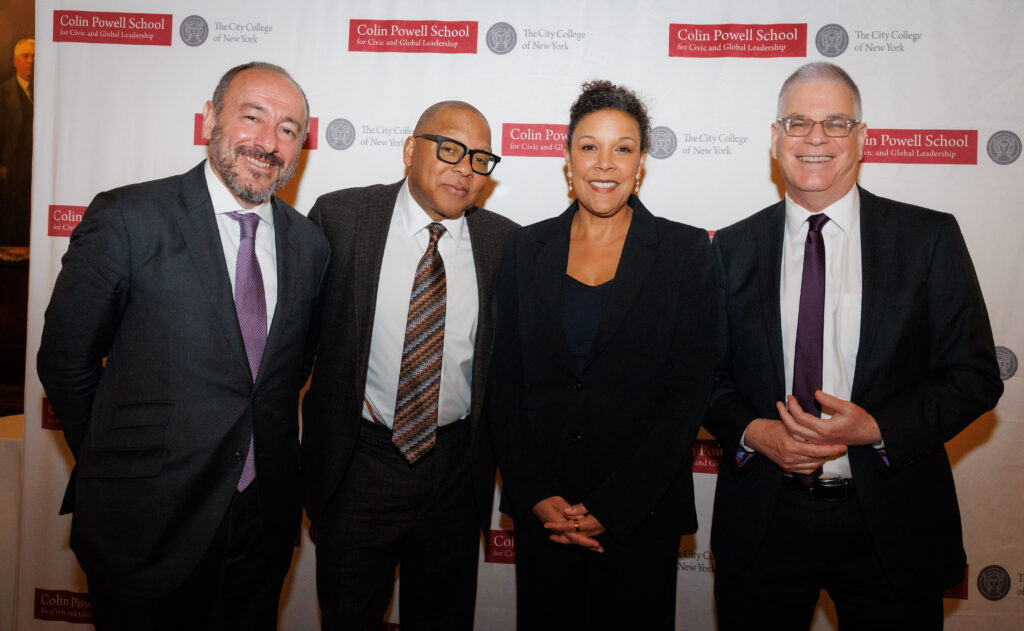
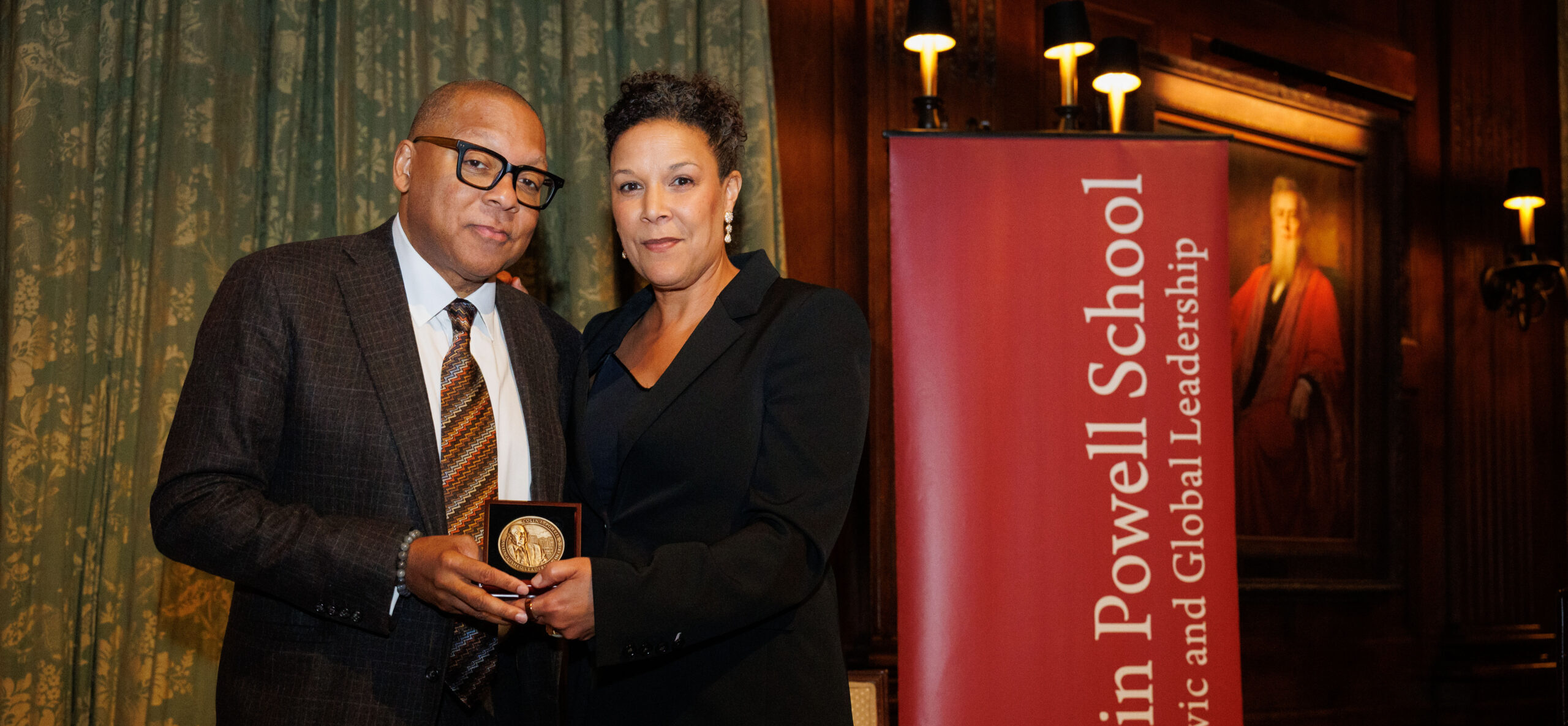
Wynton Marsalis, the acclaimed musician, composer, bandleader, educator, and cultural leader, is the 2026 recipient of the Colin L. Powell Distinguished Leadership Award, presented by the Colin Powell School for Civic and Global Leadership at The City College of New York (CCNY).
The award honors individuals who have attained the highest level of achievement in their fields and who embody the leadership values demonstrated throughout the life and career of General Colin L. Powell, a 1958 graduate of CCNY. Those values — integrity, humility, responsibility, pragmatism, and optimism — were articulated most famously in Powell’s Thirteen Rules of Leadership, which conclude with the belief that “Perpetual optimism is a force multiplier” — the words inscribed on the award medallion.
The award was presented at a ceremony in New York City earlier this month. In opening remarks, Marco Antonio Achón, co-chair of the Colin Powell School’s Board of Visitors and global head of Corporate Banking at Santander Corporate & Investment Banking, reflected on General Powell’s legacy and its continuing influence on the school.
“General Powell didn’t just walk into a room — he expanded it,” Achón said. “He made you feel seen, and then responsible for what you could become. That belief lives on at the Colin Powell School, which takes potential and gives it direction. Tonight, we honor a leader who carries those same values with discipline, clarity, and an unmistakable voice.”

In describing the evolution of the original and small Colin Powell Center into the Colin Powell School for Civic and Global Leadership, City College President Vince Boudreau recalled General Powell’s gift for “seeing the big potential of small beginnings” and how CCNY carries that spirit forward. “The identification of potential that is unrecognized and overlooked in other places is our particular brand of leadership.”
This marked the first time this award has been presented to a leader in the arts. Marc Ostfield, who became dean of the Colin Powell School in January, described the selection of Marsalis as a natural extension of the school’s mission.
“Leadership, at its core, is about using one’s talents and voice to bring people together,” Ostfield said. “Jazz reflects the very values that sustain democratic life — freedom of expression, listening, trust, and collective responsibility. Those are also the values we strive to instill in our students as future civic and global leaders.”
A native of New Orleans, Marsalis is widely regarded as one of the most influential musicians of his generation. He has won nine Grammy Awards, including the historic distinction of winning in both the jazz and classical categories in the same year at age 22. In 1997, he became the first jazz musician to receive the Pulitzer Prize for Music for Blood on the Fields, his large-scale work exploring the history of slavery and the meaning of freedom.
As managing and artistic director of Jazz at Lincoln Center, Marsalis has helped bring jazz to audiences around the world while expanding educational initiatives such as Jazz for Young People, Jazz in the Schools, and Essentially Ellington. Through these programs, he has emphasized jazz as both a musical tradition and a civic practice.
In presenting the award, Powell School Board co-chair Linda Powell celebrated both Marsalis’s achievements as a musician and also the ways in which he has also used music as a force for justice and civic engagement. Citing his 2024 collaboration with civil-rights advocate Bryan Stevenson, Freedom, Justice, and Hope, and a new civic initiative, JazzCall for Freedom, Powell said, “He has helped audiences around the world understand jazz not only as music but as a powerful expression of American history and democratic values, collaboration, discipline, listening, and respect for others.”
As part of the evening, Marsalis took part in a wide-ranging onstage conversation with actor and fellow New Orleans native Wendell Pierce, touching on art and responsibility, community and place, and the role of culture during moments of national uncertainty.
Marsalis recalled his many teachers, who instilled in their students “a belief in the universality of the experience we had.” As artists, he said, “we deal in the realm of ideas, thoughts, feelings, things that are invisible. And our job is to make them physical. . . and to manifest them with an unyielding power.”
Marsalis’s commitments extend beyond the stage. He has long advocated for post-Katrina recovery efforts in New Orleans and supported initiatives aimed at preserving the cultural life and economic vitality of communities most affected by disaster.
The Colin L. Powell Distinguished Leadership Award was conceived by Marco Antonio Achón and is made possible through the generous support of Santander. The annual program reflects the Powell School’s mission to prepare the next generation of leaders to strengthen communities, broaden opportunity, and meet the challenges of a complex world.