SOC 231: Sociological Statistics (3 Credits)

Mon. & Wed., 5:00PM-6:15PM 

Instructor: Shu-Hao Thomas Chang

An introduction to statistical theory and techniques as utilized by sociologists. This course covers descriptive and inferential statistics. 3 credits.

No prerequisite – please contact sociology advisor Prof. Gwen Dordick (gdordicksociologyadvisor@gmail.com) if needed.

Credit given for only one of the following courses: SSC 31100, SOC 23100, ECO 20150, PSY 21500.
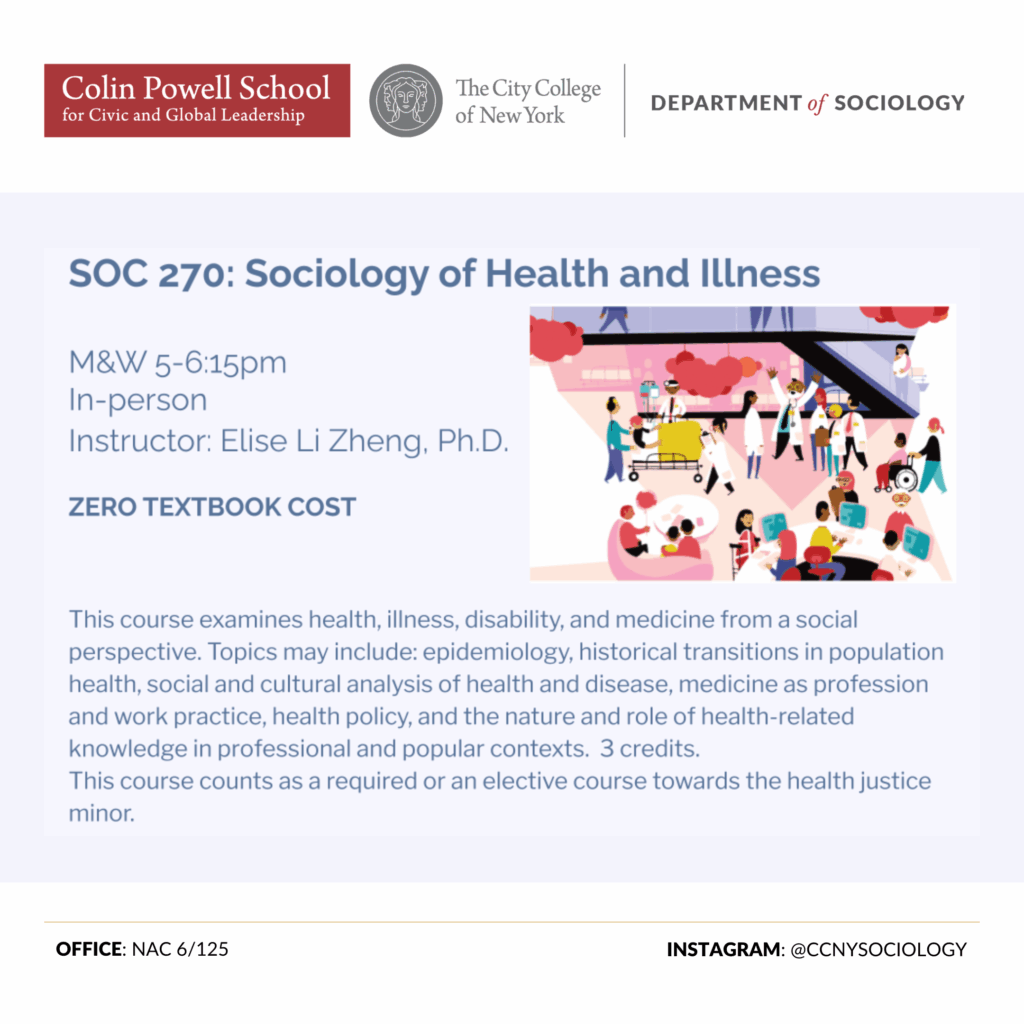
SOC 270: Sociology of Health and Illness

SOC 270: Sociology of Health and Illness (3 Credits)

Mon. & Wed., 5:00PM-6:15PM | In-Person. Zero Textbook Cost

Instructor: Elise Li Zheng, Ph.D

This course examines health, illness, disability, and medicine from a social perspective. Topics may include: epidemiology, historical transitions in population health, social and cultural analysis of health and disease, medicine as profession and work practice, health policy, and the nature and role of health-related knowledge in professional and popular contexts.

This course counts as a required or an elective course towards the health justice minor.


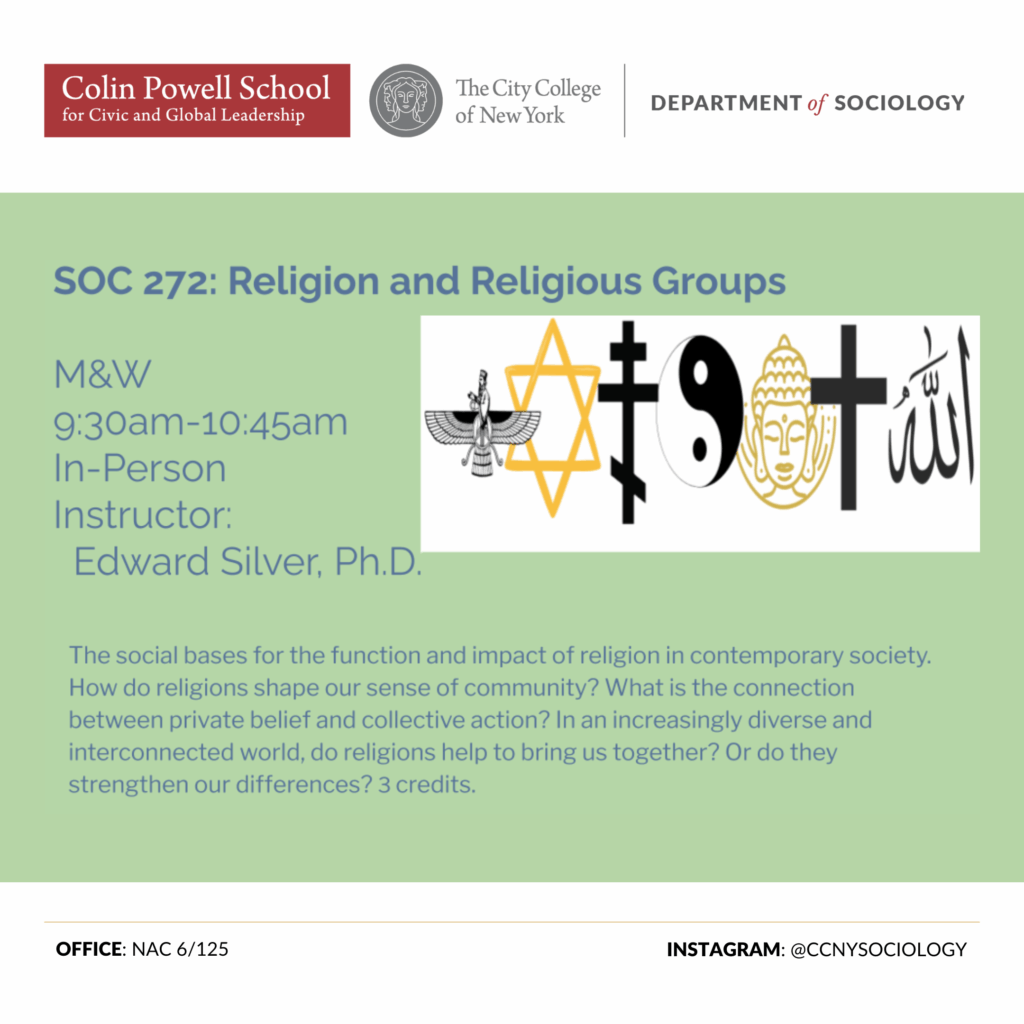
SOC 272: Religion and Religious Groups

SOC 272: Religion and Religious Groups (3 Credits)

Mon. & Wed., 9:30AM-10:45PM | In-Person. Zero Textbook Cost

Instructor: Edward Silver, Ph.D

The social bases for the function and impact of religion in contemporary society. How do religions shape our sense of community? What is the connection between private belief and collective action? In an increasingly diverse and interconnected world, do religions help to bring us together? Or do they strengthen our differences?

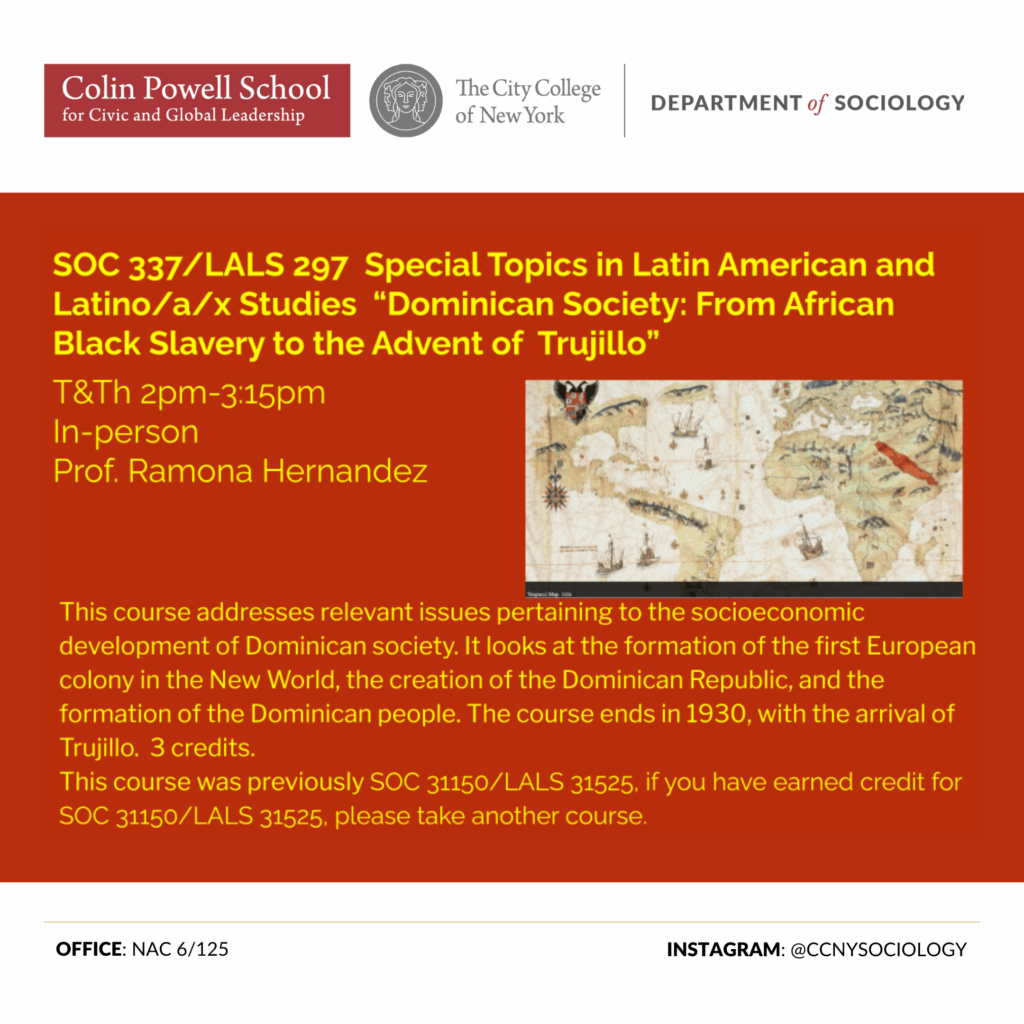
SOC 337/LALS 297: Special Topics in Latin American and Latino/a/x Studies “Dominican Society: From African Black Slavery to the Advent of Trujillo”

Tues. & Thurs., 2:00PM-3:15PM | In-Person

Instructor: Prof. Ramona Hernandez

This course addresses relevant issues pertaining to the socioeconomic development of Dominican society. It looks at the formation of the first European colony in the New World, the creation of the Dominican Republic, and the formation of the Dominican people. The course ends in 1930, with the arrival of Trujillo.

This course was previously SOC 31150/LALS 31525, if you have earned credit for SOC 31150/LALS 31525, please take another course.

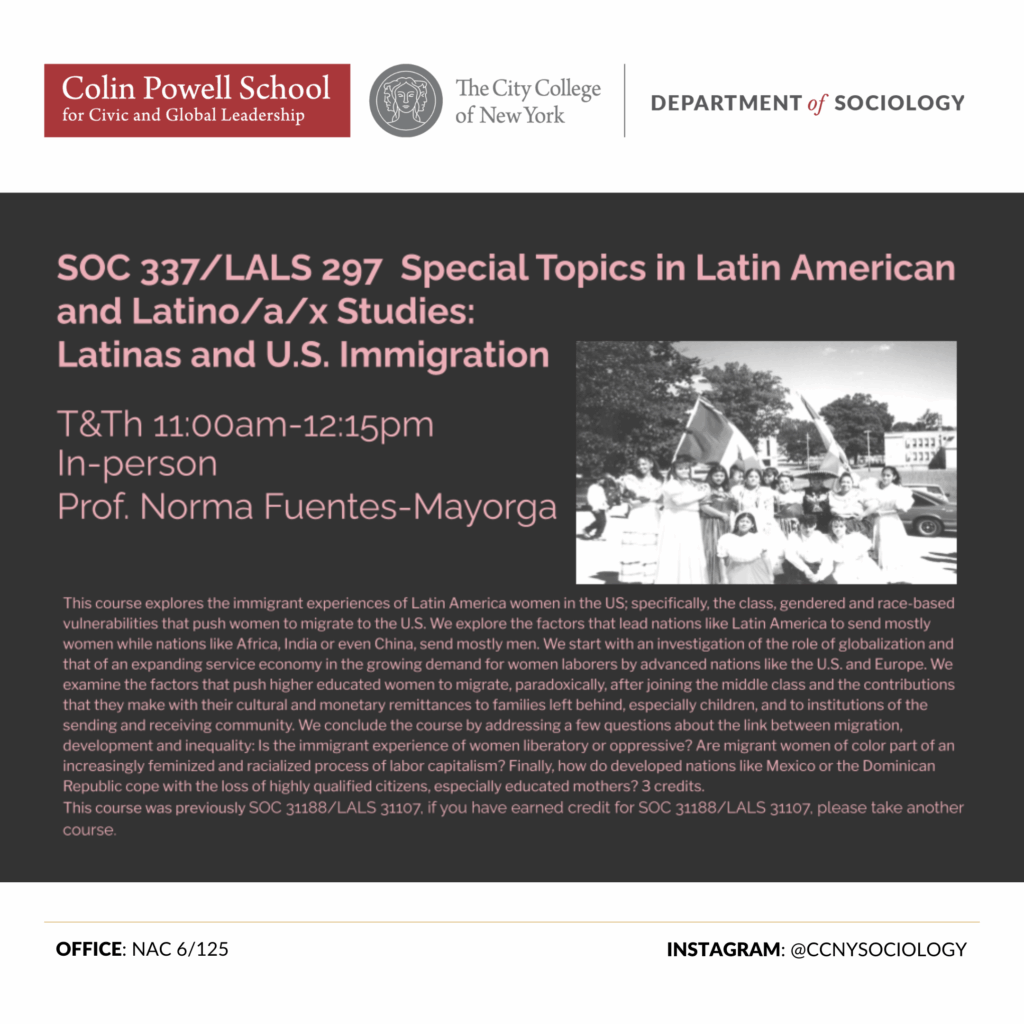
SOC 337/LALS 297: Special Topics in Latin American and Latino/a/x Studies: Latinas and U.S. Immigration

Tues. & Thurs., 11:00AM-12:15PM | In-Person

Instructor: Prof. Norma Fuentes-Mayorga

This course explores the immigrant experiences of Latin American women in the U.S. and the impact of their migration upon nations and families. We explore why countries in Latin America send mostly women to the U.S., whereas India and other countries in Africa and Asia send mostly men. We start by investigating how globalization and expanding service economies in advanced capitalist nations have increased the demand for immigrant women workers. We also examine why higher educated women migrate from developed countries of Latin America, like Mexico and the Dominican Republic, and the cultural and monetarized contributions they send back to families and children in communities of origin. In addition, we analyze the links among development, migration, and inequality and explore how migration introduces new forms of independence as well as oppression in women’s lives. Finally, we question how developing nations cope with the absence of citizens, especially higher educated mothers.

This course was previously SOC 31188/LALS 31107, if you have earned credit for SOC 31188/LALS 31107, please take another course.

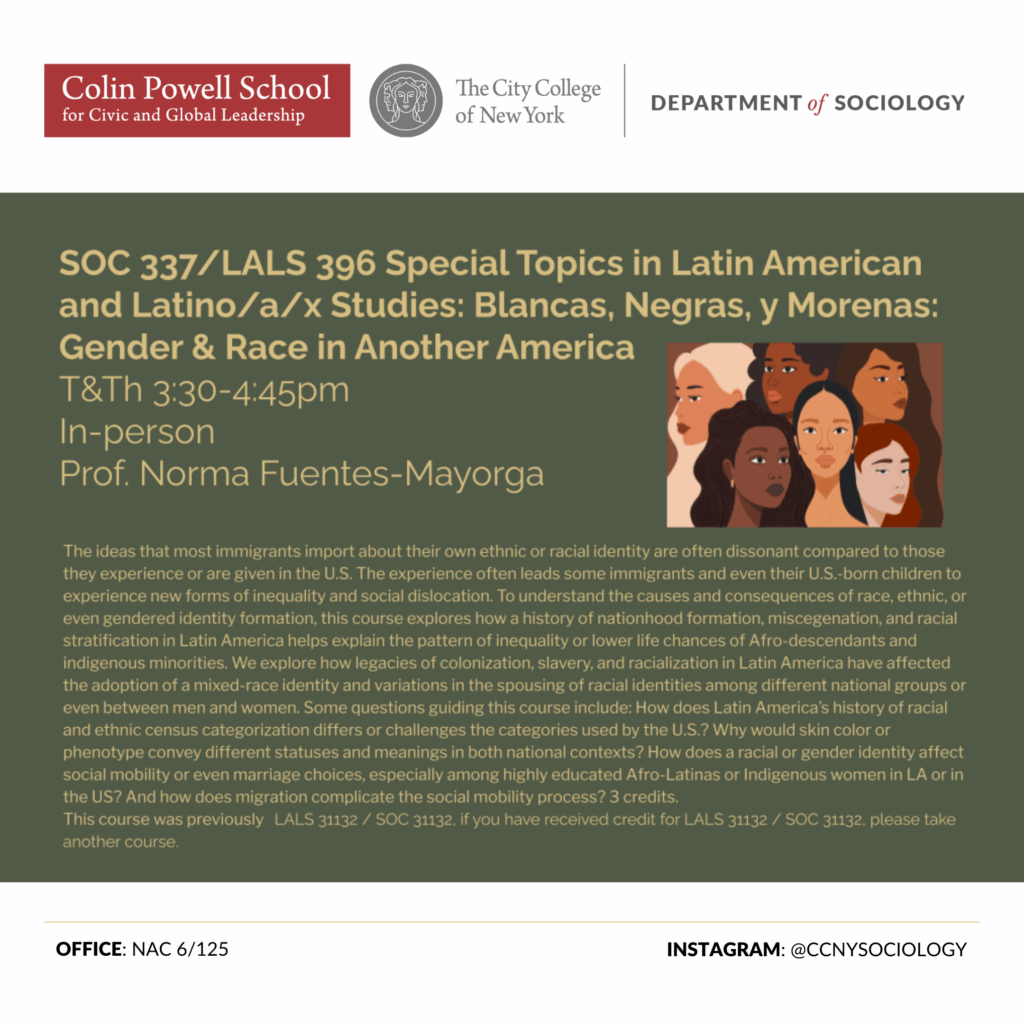
SOC 337/LALS 396 Special Topics in Latin American and Latino/a/x Studies: Blancas, Negras, y Morenas: Gender & Race in Another America

SOC 337/LALS 396 Special Topics in Latin American and Latino/a/x Studies: Blancas, Negras, y Morenas: Gender & Race in Another America

Tues. & Thurs., 3:30PM-4:45PM | In-Person

Instructor: Prof. Norma Fuentes-Mayorga

The ideas that most immigrants import about their own ethnic or racial identity are often dissonant compared to those they experience or are given in the U.S. The experience often leads some immigrants and even their U.S.-born children to experience new forms of inequality and social dislocation. To understand the causes and consequences of race, ethnic, or even gendered identity formation, this course explores how a history of nationhood formation, miscegenation, and racial stratification in Latin America helps explain the pattern of inequality or lower life chances of Afro-descendants and indigenous minorities. We explore how legacies of colonization, slavery, and racialization in Latin America have affected the adoption of a mixed-race identity and variations in the spousing of racial identities among different national groups or even between men and women. Some questions guiding this course include:

  • How does Latin America’s history of racial and ethnic census categorization differs or challenges the categories used by the U.S.?
  • Why would skin color or phenotype convey different statuses and meanings in both national contexts?
  • How does a racial or gender identity affect social mobility or even marriage choices, especially among highly educated Afro-Latinas or Indigenous women in LA or in the US? And how does migration complicate the social mobility process?

This course was previously LALS 31132 / SOC 31132, if you have received credit for LALS 31132 / SOC 31132, please take another course.

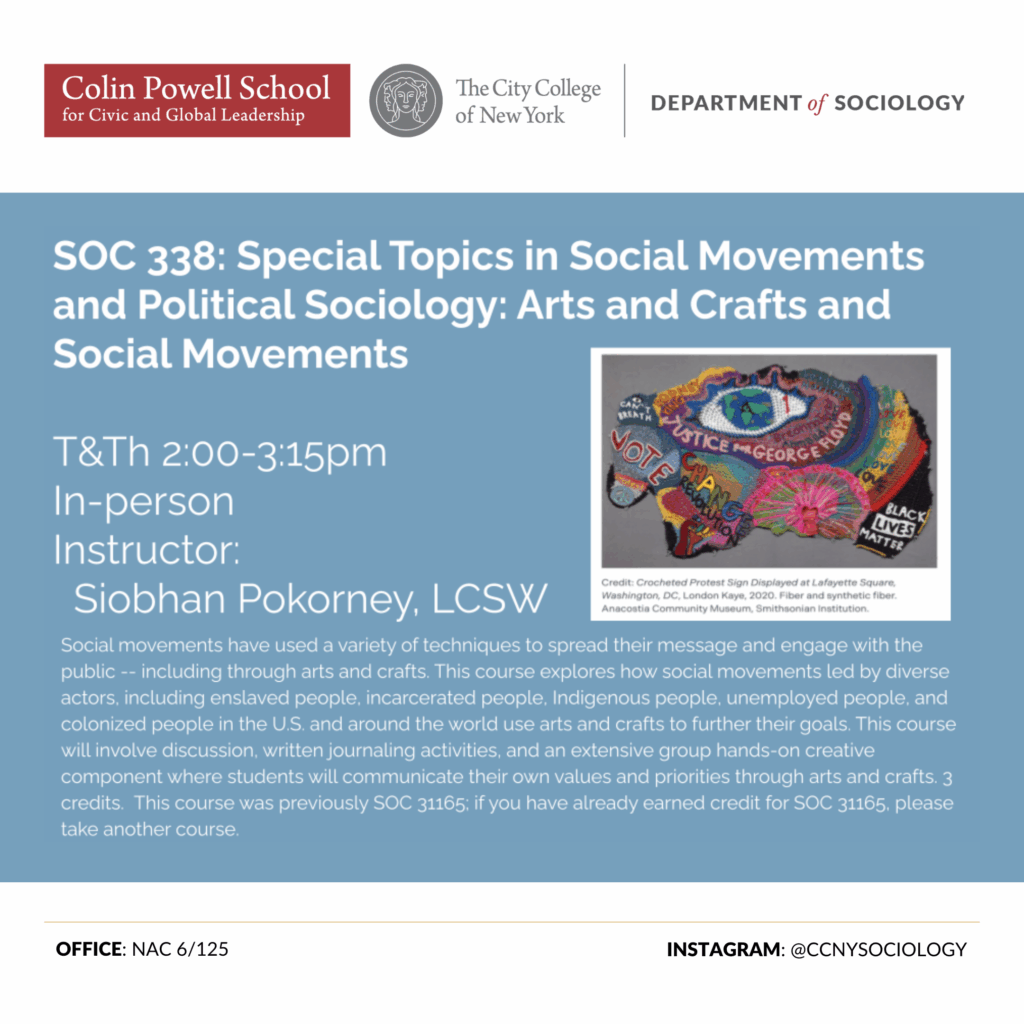
SOC 338: Special Topics in Social Movements and Political Sociology: Arts and Crafts and Social Movements

Tues. & Thurs., 2:00PM-3:15PM | In-Person

Instructor: Siobhan Pokorney, LCSW

Social movements have used a variety of techniques to spread their message and engage with the public — including through arts and crafts. This course explores how social movements led by diverse actors, including enslaved people, incarcerated people, Indigenous people, unemployed people, and colonized people in the U.S. and around the world use arts and crafts to further their goals. This course will involve discussion, written journaling activities, and an extensive group hands-on creative component where students will communicate their own values and priorities through arts and crafts. 3 credits.

Note: This course was previously SOC 31165; if you have already earned credit for SOC 31165, please take another course.


SOC 340 Special Topics in Community and Urban Sociology

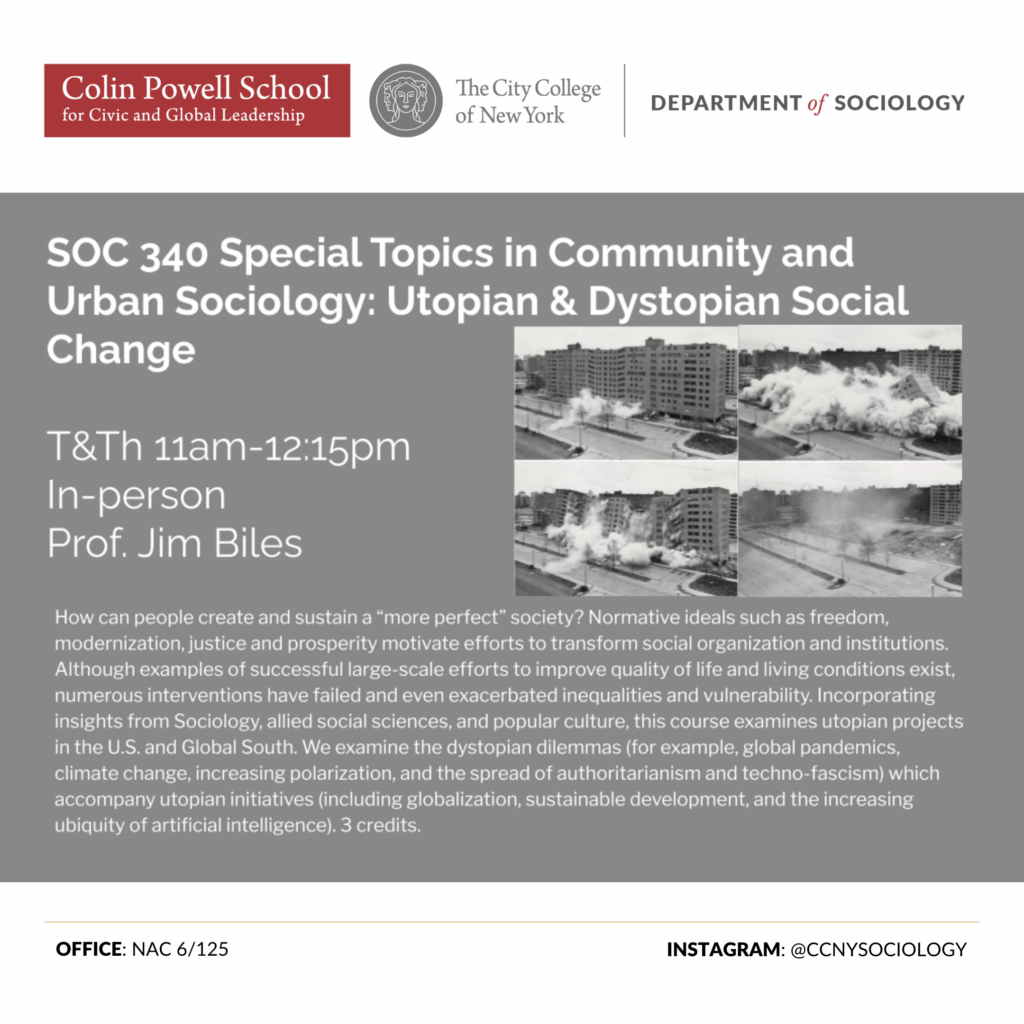
SOC 340: Special Topics in Community and Urban Sociology: Utopian & Dystopian Social Change

Tues. & Thurs., 11:00AM-12:15PM | In-Person

Instructor: Prof. Jim Biles

How can people create and sustain a “more perfect” society? Normative ideals such as freedom, modernization, justice and prosperity motivate efforts to transform social organization and institutions. Although examples of successful large-scale efforts to improve quality of life and living conditions exist, numerous interventions have failed and even exacerbated inequalities and vulnerability. Incorporating insights from Sociology, allied social sciences, and popular culture, this course examines utopian projects in the U.S. and Global South. We examine the dystopian dilemmas (for example, global pandemics, climate change, increasing polarization, and the spread of authoritarianism and techno-fascism) which accompany utopian initiatives (including globalization, sustainable development, and the increasing ubiquity of artificial intelligence).


SOC 347/PSY 31163 Special Topics in Social Work: Child Welfare Systems: State Regulation and the Family

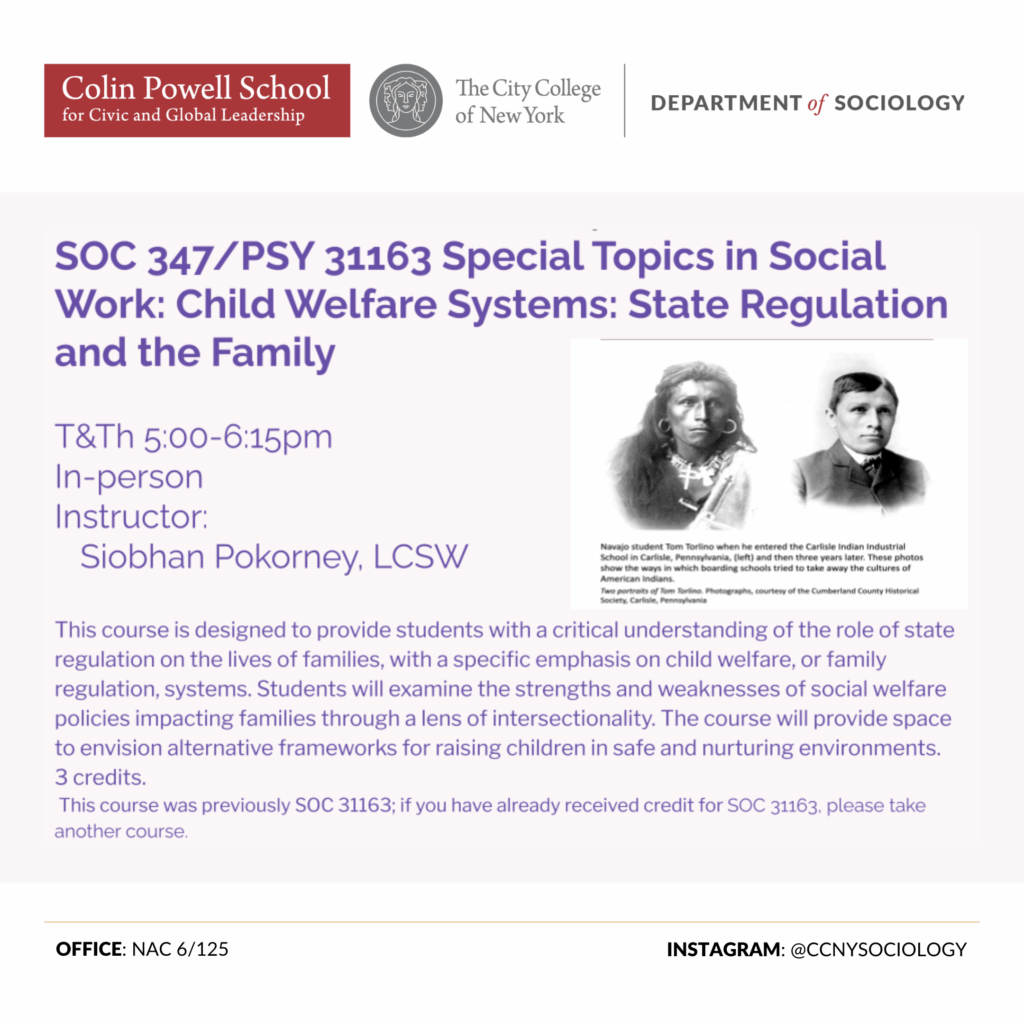
SOC 347/PSY 31163 Special Topics in Social Work: Child Welfare Systems: State Regulation and the Family

Tues. & Thurs., 5:00PM-6:15PM | In-Person

Instructor: Siobhan Pokorney LCSW

This course is designed to provide students with a critical understanding of the role of state regulation on the lives of families, with a specific emphasis on child welfare, or family regulation, systems. Students will examine the strengths and weaknesses of social welfare policies impacting families through a lens of intersectionality. The course will provide space to envision alternative frameworks for raising children in safe and nurturing environments.

Note: This course was previously SOC 31163; if you have already received credit for SOC 31163, please take another course.

SOC 23700: Foundations of Sociological Theory

SOC 23700: Foundations of Sociological Theory

Mon. & Weds., 6:30PM-7:45PM
Tues. & Thurs., 11:00AM-12:15PM
| Hybrid Asynchronous, Zero Textbook Cost + Low Textbook Cost

Instructor: Prof. Maritsa Poros

The roots of modern sociology in the ideas of nineteenth and early twentieth century theorists, such as Marx, Weber, Durkheim, Simmel, Veblen and Cooley, with emphasis on the intellectual and social context and current relevance of the concepts and propositions they developed. This 4-credit course requires additional work outside of class, including flipped lectures, readings, and assignments. This course is required for all sociology majors.

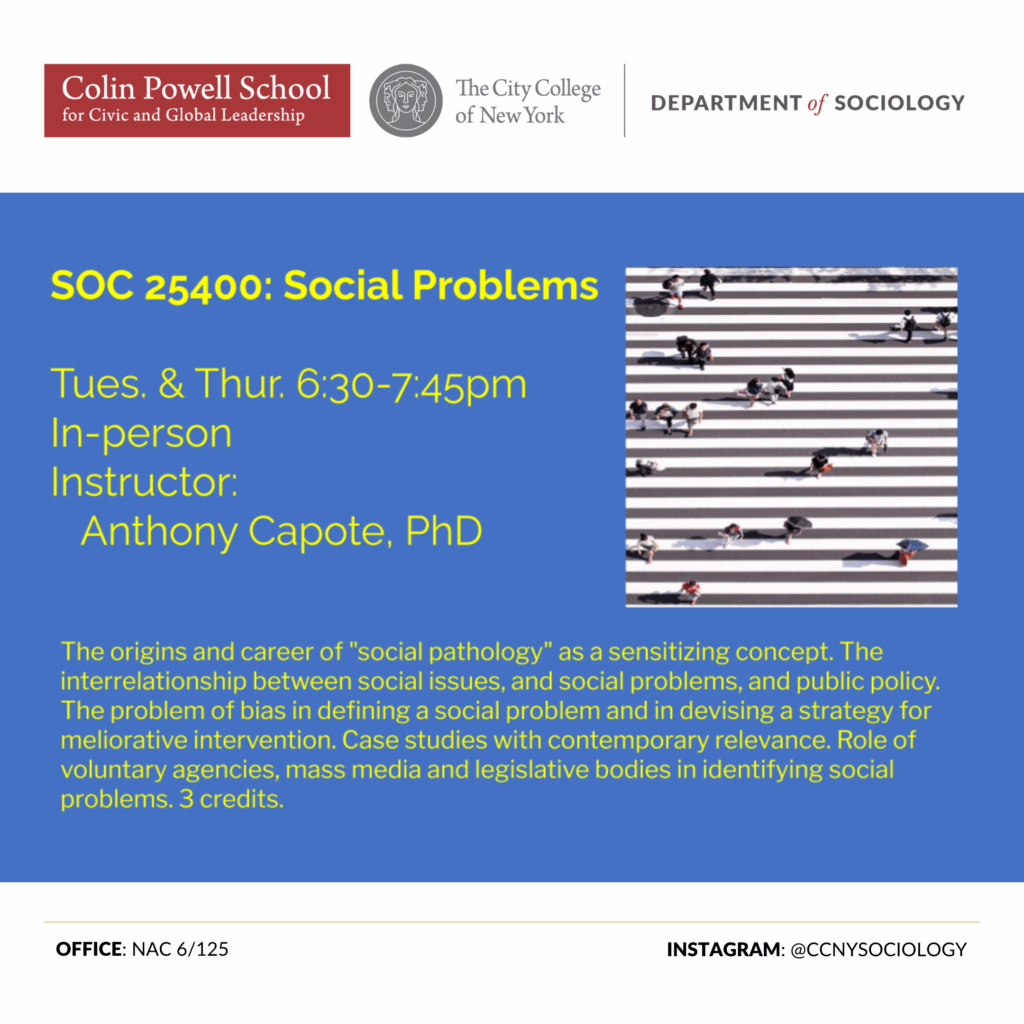
SOC 25400: Social Problems

Tues. & Thurs., 6:30PM-7:45PM | In-Person

Instructor: Anthony Capote, Ph.D

The origins and career of “social pathology” as a sensitizing concept. The interrelationship between social issues, and social problems, and public policy. The problem of bias in defining a social problem and in devising a strategy for meliorative intervention. Case studies with contemporary relevance. Role of voluntary agencies, mass media and legislative bodies in identifying social problems.

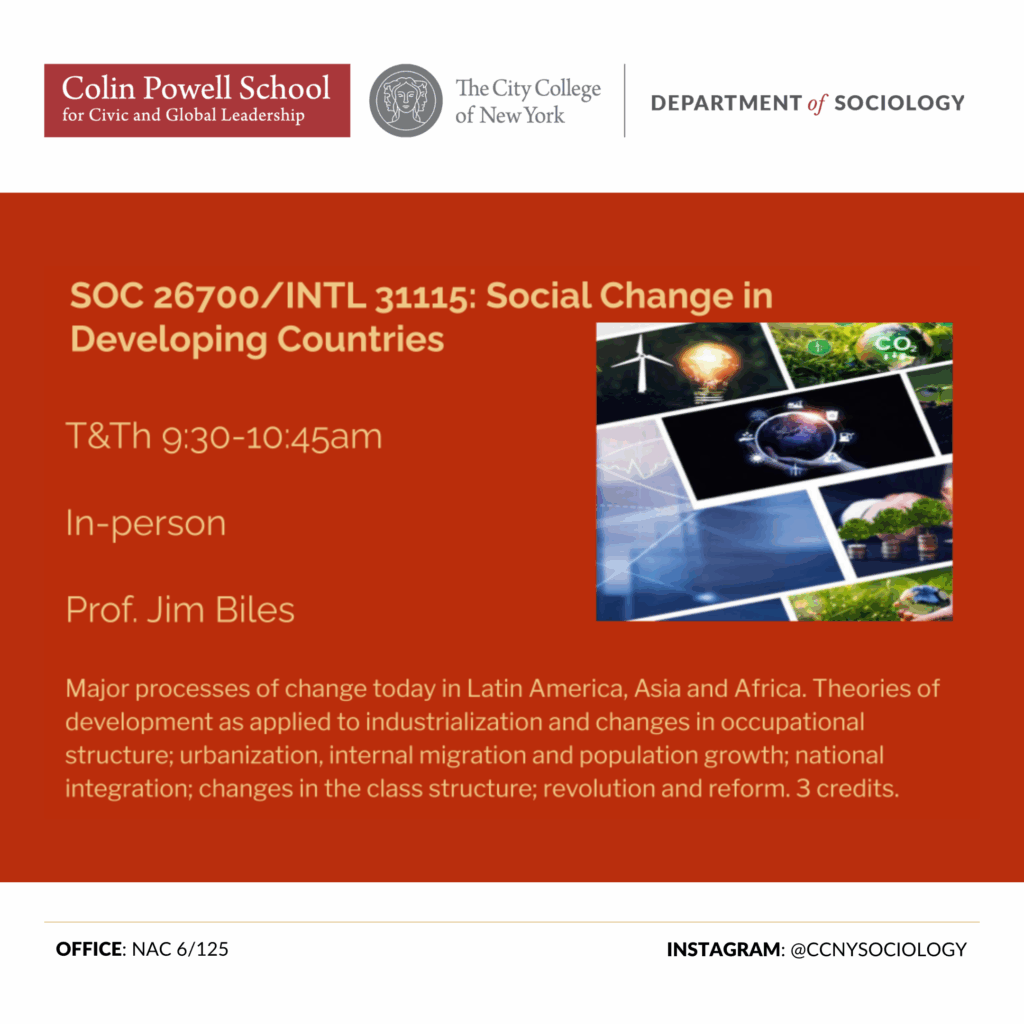
SOC 26700/INTL 31115: Social Change in Developing Countries

SOC 26700/INTL 31115: Social Change in Developing Countries

Tues. & Thurs., 9:30AM-10:45AM | In-Person

Instructor: Prof. Jim Biles

Major processes of change today in Latin America, Asia and Africa. Theories of development as applied to industrialization and changes in occupational structure; urbanization, internal migration and population growth; national integration; changes in the class structure; revolution and reform.

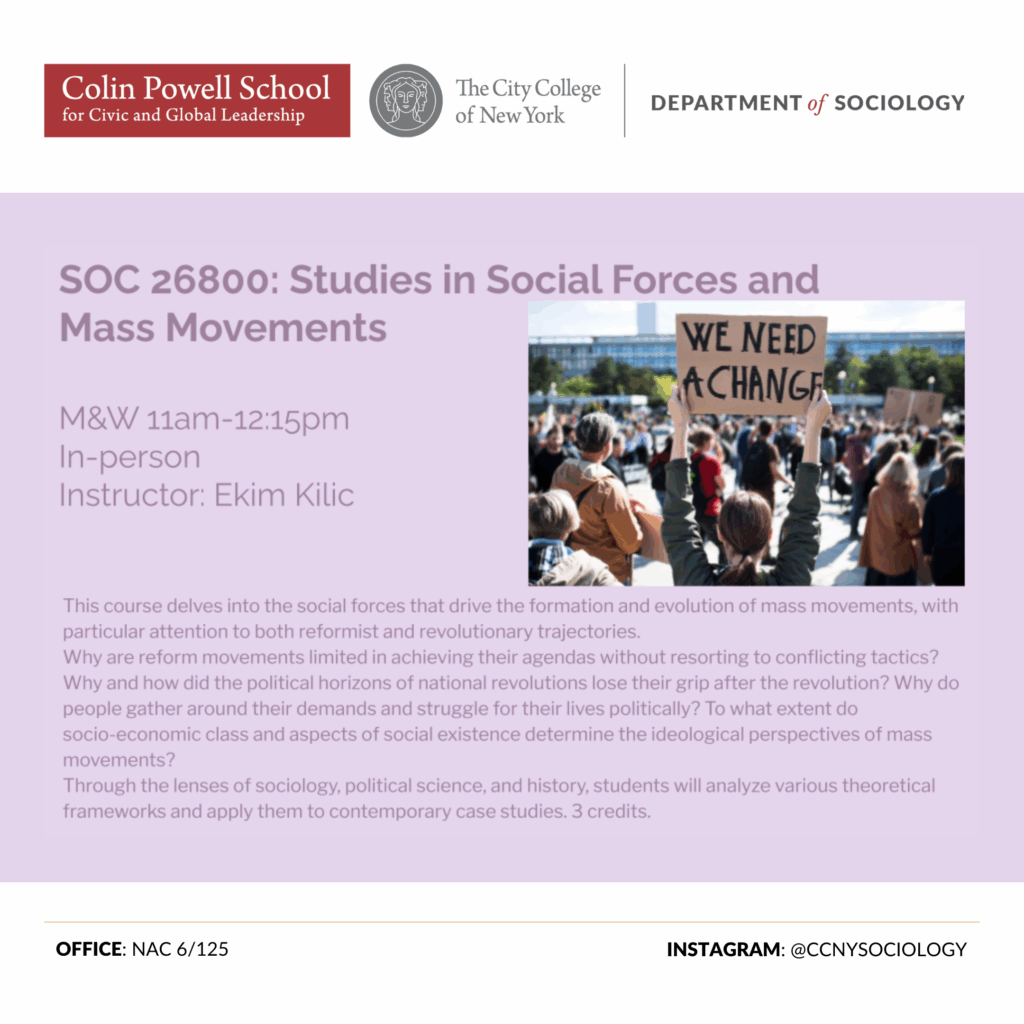
SOC 26800: Studies in Social Forces and Mass Movements

SOC 26800: Studies in Social Forces and Mass Movements

Mon. & Weds., 11:00AM-12:15PM | In-Person

Instructor: Ekim Kilic

This course delves into the social forces that drive the formation and evolution of mass movements, with particular attention to both reformist and revolutionary trajectories.

  • Why are reform movements limited in achieving their agendas without resorting to conflicting tactics?
  • Why and how did the political horizons of national revolutions lose their grip after the revolution?
  • Why do people gather around their demands and struggle for their lives politically?
  • To what extent do socio-economic class and aspects of social existence determine the ideological perspectives of mass movements?
  • Through the lenses of sociology, political science, and history, students will analyze various theoretical frameworks and apply them to contemporary case studies.
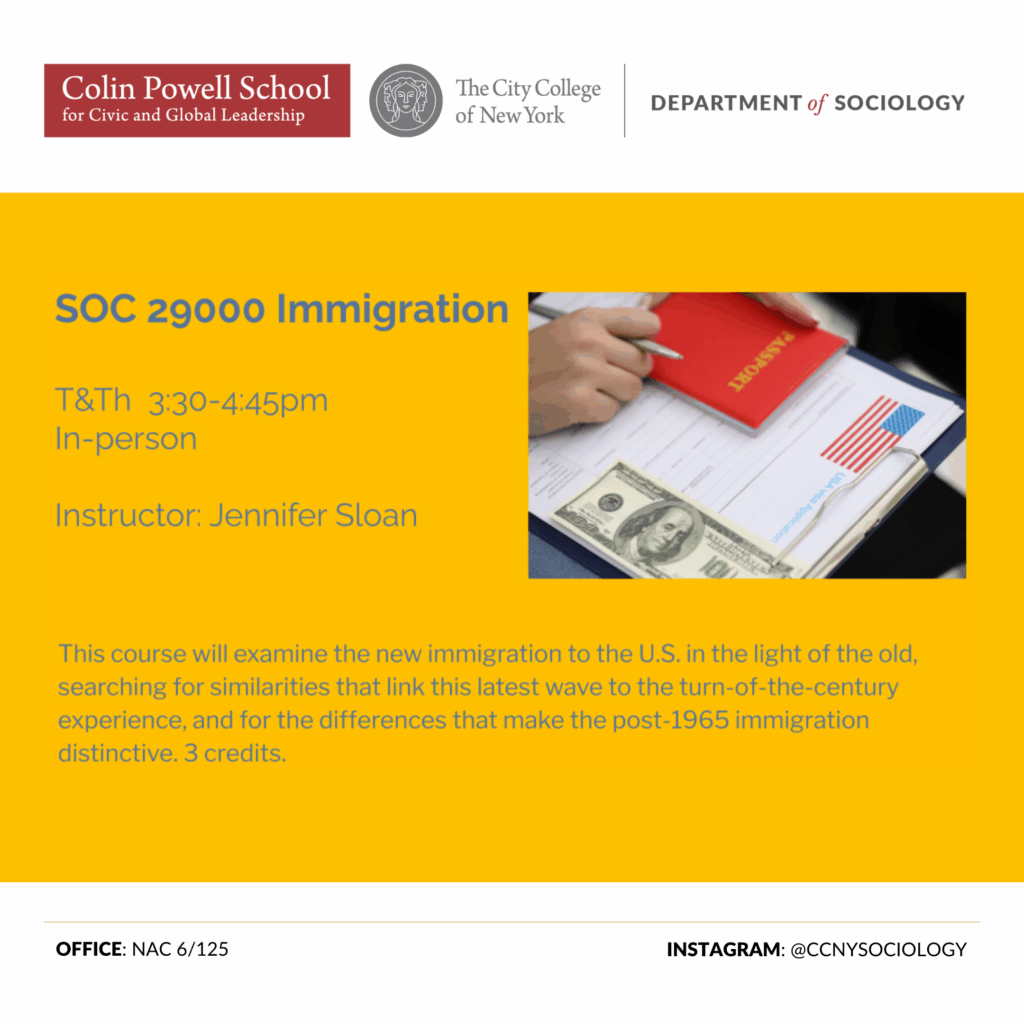
SOC 29000: Immigration

SOC 29000: Immigration

Tues. & Thurs., 3:30PM-4:45PM | In-Person

Instructor: Jennifer Sloan

This course will examine the new immigration to the U.S. in the light of the old, searching for similarities that link this latest wave to the turn-of-the-century experience, and for the differences that make the post-1965 immigration distinctive.

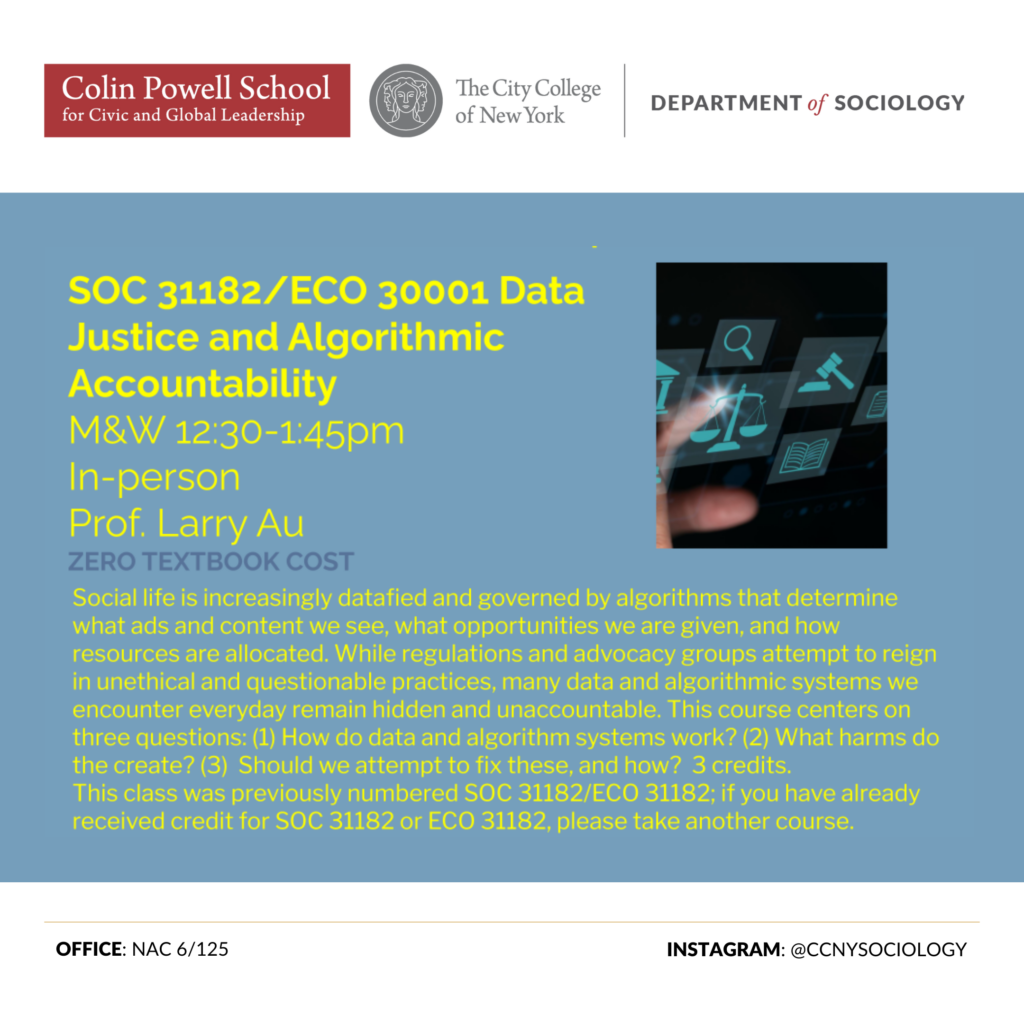
SOC 31182/ECO 30001 Data Justice and Algorithmic Accountability

SOC 31182/ECO 30001 Data Justice and Algorithmic Accountability

Mon. & Weds., 12:30PM-1:45PM | In-Person, Zero Textbook Cost

Instructor: Prof. Larry Au

Social life is increasingly datafied and governed by algorithms that determine what ads and content we see, what opportunities we are given, and how resources are allocated. While regulations and advocacy groups attempt to reign in unethical and questionable practices, many data and algorithmic systems we encounter everyday remain hidden and unaccountable. This course centers on three questions:

  1. How do data and algorithm systems work?
  2. What harms do the create?
  3. Should we attempt to fix these, and how?

Note: This class was previously numbered SOC 31182/ECO 31182; if you have already received credit for SOC 31182 or ECO 31182, please take another course.

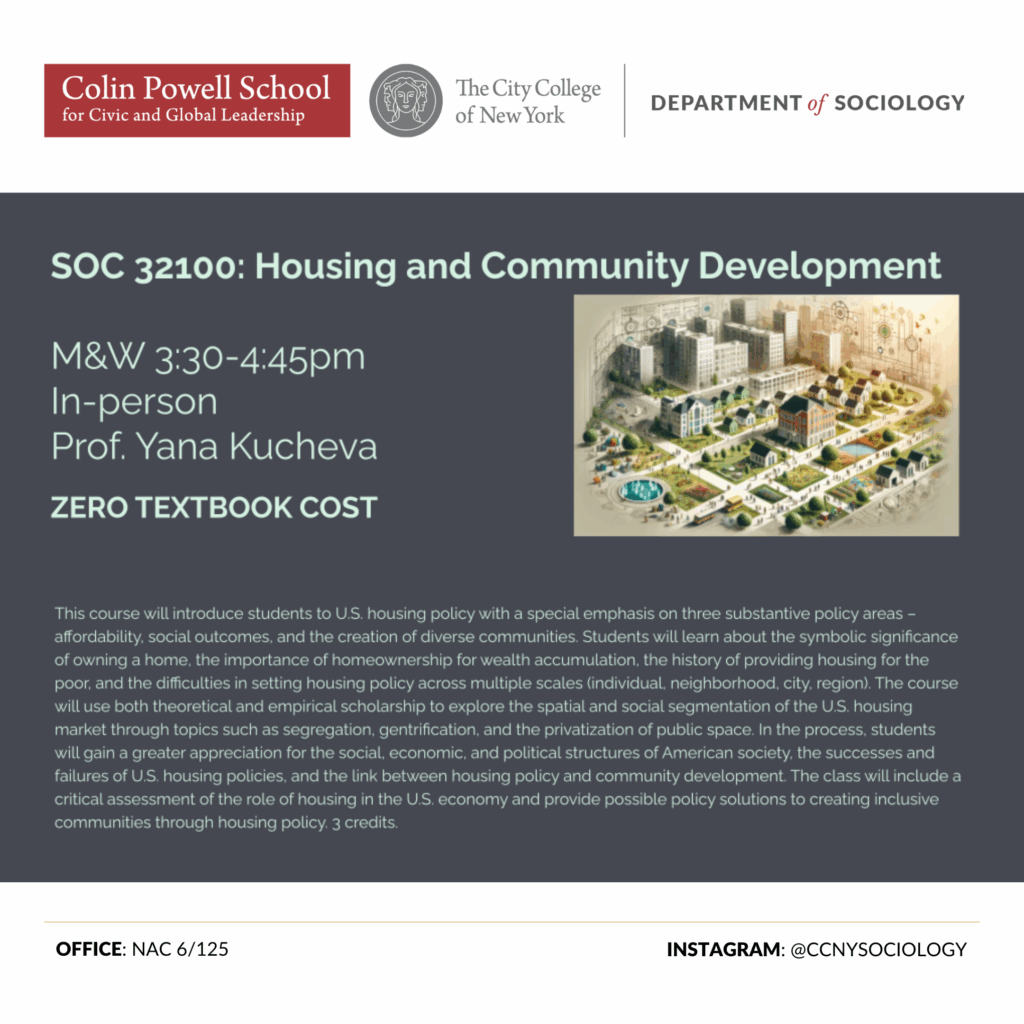
SOC 32100: Housing and Community Development

SOC 32100: Housing and Community Development

Mon. & Weds., 3:30PM-4:45PM | In-Person

Instructor: Prof. Yana Kucheva

This course will introduce students to U.S. housing policy with a special emphasis on three substantive policy areas – affordability, social outcomes, and the creation of diverse communities. Students will learn about the symbolic significance of owning a home, the importance of homeownership for wealth accumulation, the history of providing housing for the poor, and the difficulties in setting housing policy across multiple scales (individual, neighborhood, city, region). The course will use both theoretical and empirical scholarship to explore the spatial and social segmentation of the U.S. housing market through topics such as segregation, gentrification, and the privatization of public space. In the process, students will gain a greater appreciation for the social, economic, and political structures of American society, the successes and failures of U.S. housing policies, and the link between housing policy and community development. The class will include a critical assessment of the role of housing in the U.S. economy and provide possible policy solutions to creating inclusive communities through housing policy.


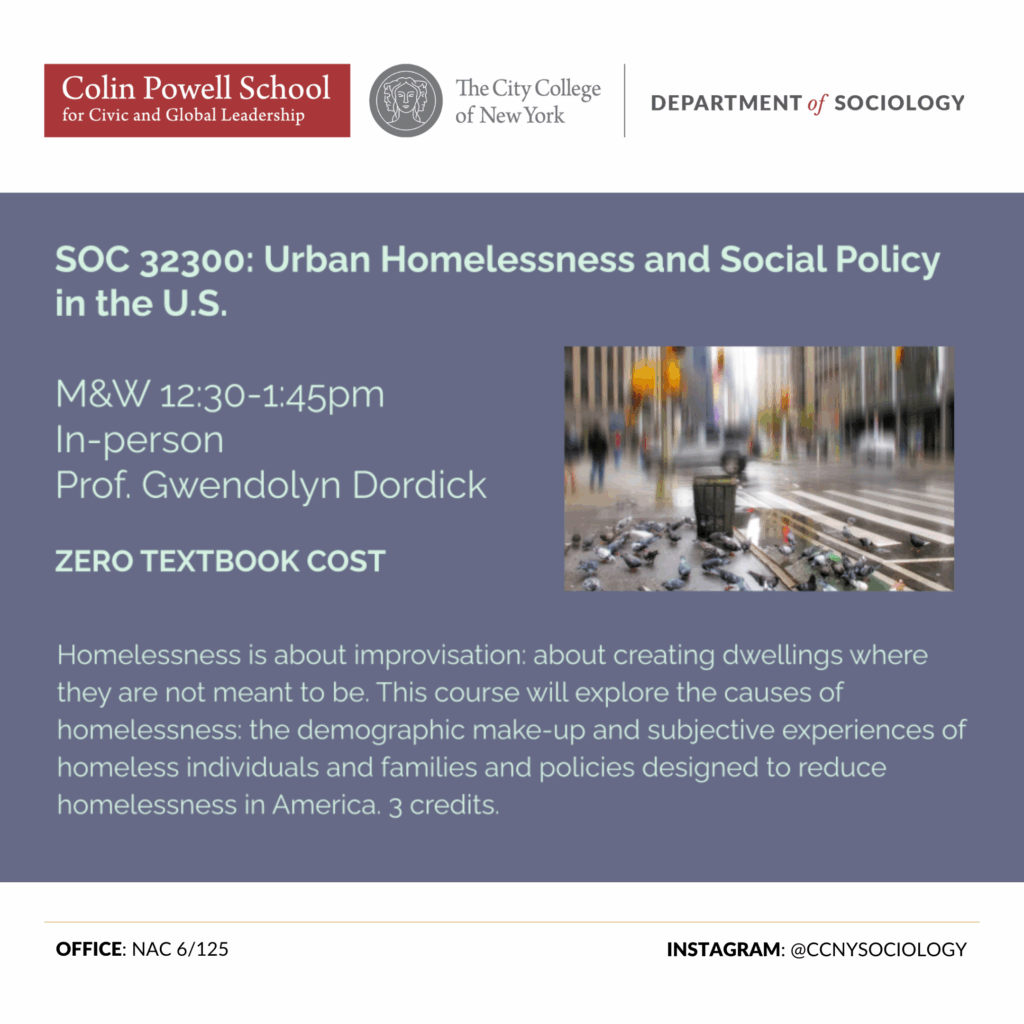
SOC 32300: Urban Homelessness and Social Policy in the U.S.

SOC 32300: Urban Homelessness and Social Policy in the U.S.

Mon. & Weds., 12:30PM-1:45PM | In-Person, Zero Textbook Cost

Instructor: Prof. Gwendolyn Dordick

Homelessness is about improvisation: about creating dwellings where they are not meant to be. This course will explore the causes of homelessness: the demographic make-up and subjective experiences of homeless individuals and families and policies designed to reduce homelessness in America.

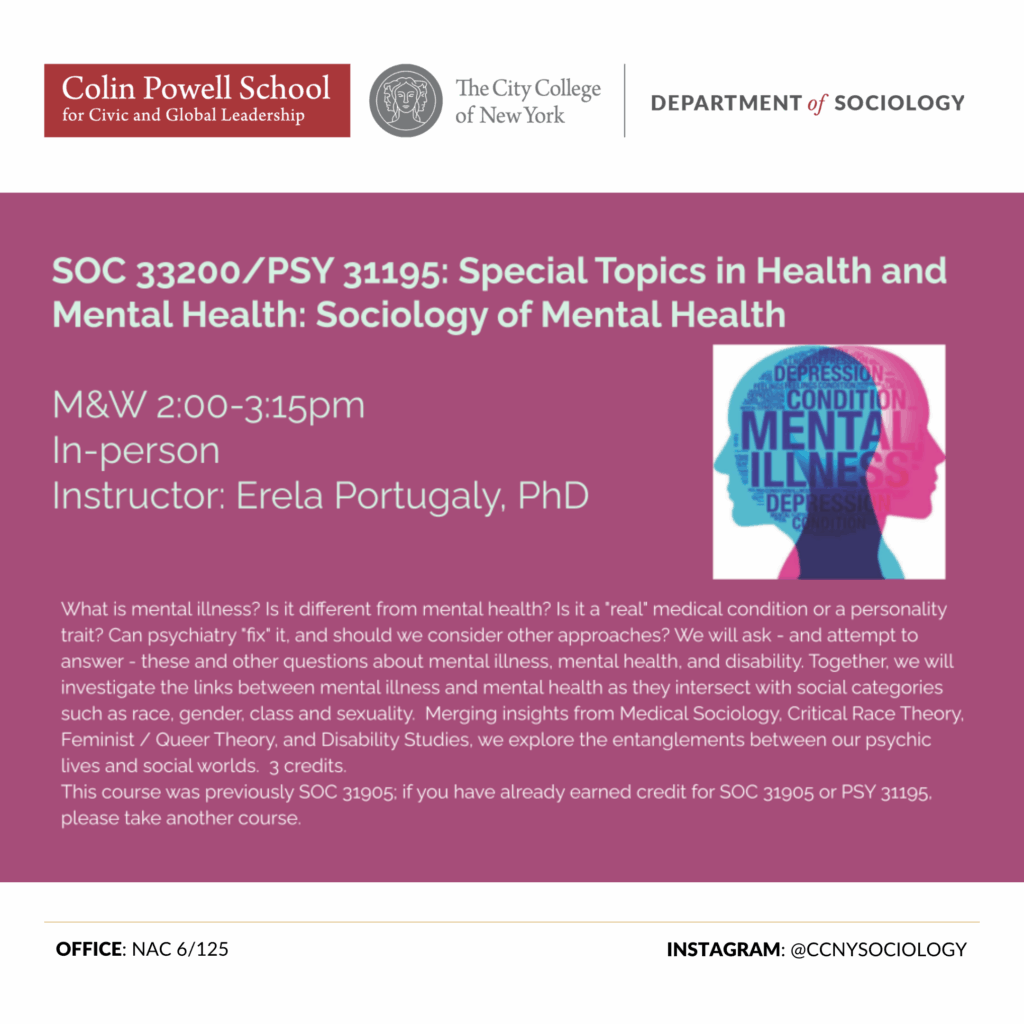
SOC 33200/PSY 31195: Special Topics in Health and Mental Health: Sociology of Mental Health

SOC 33200/PSY 31195: Special Topics in Health and Mental Health: Sociology of Mental Health

Mon. & Weds., 2:00PM-3:15PM | In-Person

Instructor: Erela Portugaly, Ph.D

What is mental illness? Is it different from mental health? Is it a “real” medical condition or a personality trait? Can psychiatry “fix” it, and should we consider other approaches? We will ask – and attempt to answer – these and other questions about mental illness, mental health, and disability. Together, we will investigate the links between mental illness and mental health as they intersect with social categories such as race, gender, class and sexuality. Merging insights from Medical Sociology, Critical Race Theory, Feminist / Queer Theory, and Disability Studies, we explore the entanglements between our psychic lives and social worlds.

Note: This course was previously SOC 31905; if you have already earned credit for SOC 31905 or PSY 31195, please take another course.

SOC 34100 / PSY 314-10: Disability Studies

SOC 34100 / PSY 314-10: Disability Studies

Mon. & Weds., 2:00PM-3:15PM | In-Person, Zero Textbook Cost

Instructor: Prof. Jack Levinson

Surveys this transformative interdisciplinary field, informed by critical approaches to race, gender and sexuality, which offers an approach to disability as a social, political, and cultural category and a personal identity and lived experience. Readings include current and historical material, theoretical and empirical, from the social sciences, humanities, and arts.

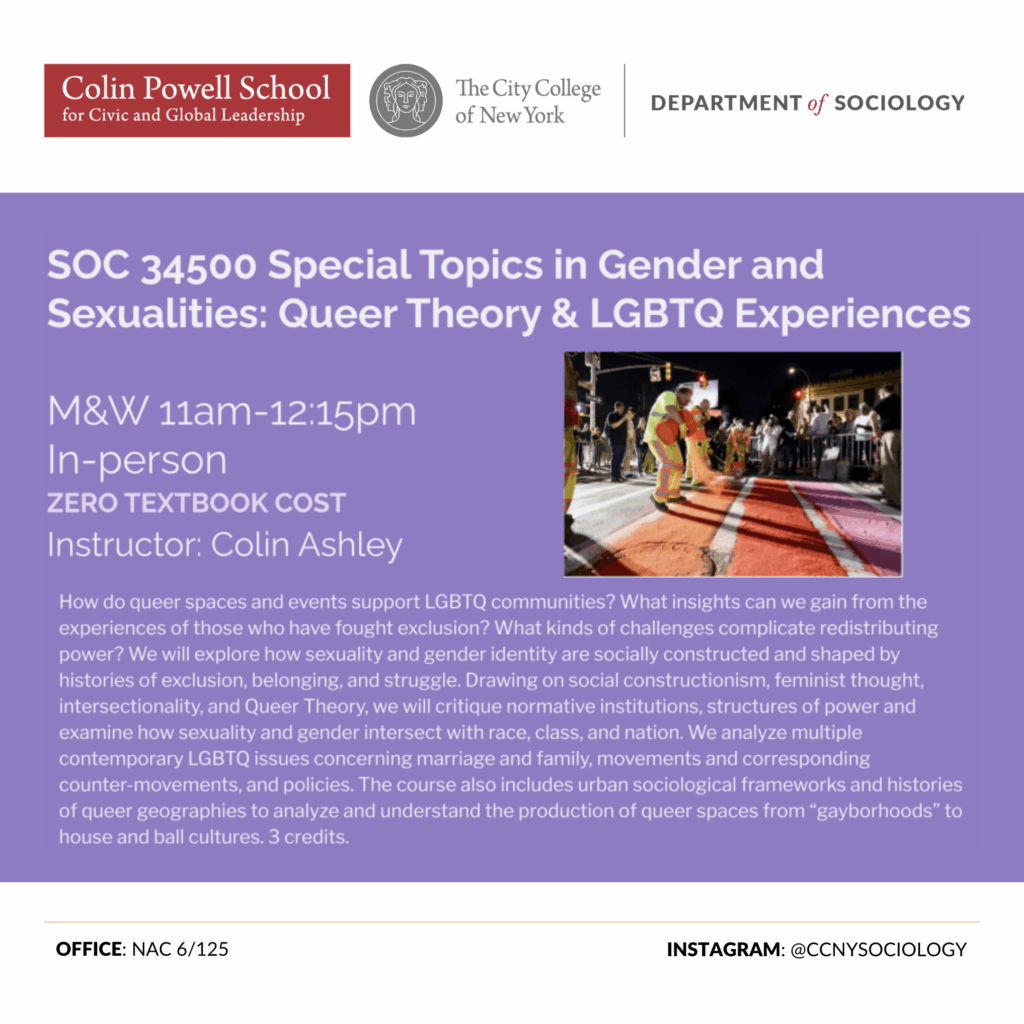
SOC 34500 Special Topics in Gender and Sexualities: Queer Theory & LGBTQ Experiences

SOC 34500 Special Topics in Gender and Sexualities: Queer Theory & LGBTQ Experiences

Mon. & Weds., 11:00AM-12:15PM | In-Person, Zero Textbook Cost

Instructor: Colin Ashley

How do queer spaces and events support LGBTQ communities? What insights can we gain from the experiences of those who have fought exclusion? What kinds of challenges complicate redistributing power? We will explore how sexuality and gender identity are socially constructed and shaped by histories of exclusion, belonging, and struggle. Drawing on social constructionism, feminist thought, intersectionality, and Queer Theory, we will critique normative institutions, structures of power and examine how sexuality and gender intersect with race, class, and nation. We analyze multiple contemporary LGBTQ issues concerning marriage and family, movements and corresponding counter-movements, and policies. The course also includes urban sociological frameworks and histories of queer geographies to analyze and understand the production of queer spaces from “gayborhoods” to house and ball cultures.

SOC 38107: Justice, Law, and Society

SOC 38107: Justice, Law, and Society

Mon. & Weds., 6:30PM-7:45PM | In-Person

Instructor: Ian Heller, JD

This course looks at theories about law, the practical application of law in the justice system, and peoples’ own perceptions of the law. It explores how those aspects of law often differ from one another and considers the implications of those gaps in understanding.

SOC 38211 Drugs and Society

SOC 38211 Drugs and Society

Mon. & Weds., 3:30PM-4:45PM | In-Person

Instructor: Prof. Jack Levinson

This course examines psychoactive drug use in social and historical context, and includes both illegal and medical drug use. Topics may include: varying patterns of use, addiction and treatment, epidemiology, drug control policy and enforcement, drug markets, prescribing practice, and very basic pharmacology (how drugs work in the body).

SOC 10500: Individual, Group and Society: An Introduction to Sociology

SOC 10500: Individual, Group and Society: An Introduction to Sociology

Mon. & Weds., 9:30AM-10:45AM, Erela Portugaly, Ph.D
Mon. & Weds., 2:00PM-3:15PM, Prof. Gwendolyn Dordick
Tues. & Thurs., 9:30AM-10:45AM, Jeniffer Sloan
Tues. & Thurs., 5:00AM-6:15PM, Talha Issevenler, Ph.D
Friday, 9:30AM-11:30AM, Edward Silver, Ph.D
Friday, 12:00AM-2:30PM, Colin Ashley

All In-Person, Zero Textbook Cost

The language of sociology, the sociological perspective, and basic areas of sociological inquiry. Topics include: culture, socialization, self and society, social stratification and social class, the family, religion, policy, community organization, collective behavior, mass culture, social order and social change.

Note: This course fulfills a general education requirement and is required for Sociology majors and minors.